
Are Air Circulators Better Than Fans? The Science of Indoor Airflo
When summer hits, people rush to buy cooling appliances. Most consumers grab a standard desk fan, plug it in, and expect miracles. But standard fans often leave rooms feeling stuffy and unevenly cooled.
This frustration leads to a very common question: Is an air circulator actually better than a traditional fan? The short answer is yes. Their outside design look similar , but their internal engineering and physical effects on your room are entirely different. An air circulator does not just blow wind at you; it actively improves the air flow and climate of your entire living space.
The Flaw of Traditional Fans: The "Direct Breeze" Problem
To understand why circulators are superior, you must understand how traditional fans fail.
A standard pedestal or desk fan relies on a very basic mechanical process. Flat blades chop the air and push a direct, localized breeze toward your body. Walk two steps away, and you lose the cooling effect entirely.
More importantly, standard fans never actually change the room's environment. They just blow stale, hot air across your skin to evaporate sweat. If a corner of your room is hot and stuffy, it stays hot and stuffy. The moment you turn the machine off, the heat instantly returns. For modern, comfortable living, this localized approach cuts it no longer.
The Circulator Advantage: Aerodynamics and Continuous Convection
Air circulators fix this exact flaw. They do not just blow air at you. They utilize advanced fluid dynamics, utilizing deep-pitch aerodynamic blades enclosed in a directional grill.
The principle behind an air circulator is to promote continuous indoor airflow. It draws air in from the rear and directs it forward, creating a focused stream of air that can travel across the room. Rather than simply blowing air directly toward you, you can aim the circulator toward an open area or adjust its angle to encourage air movement throughout the space. As the moving air interacts with the surrounding air, it helps promote circulation and mixing, reducing areas with limited airflow and helping create a more comfortable indoor environment.
Air Circulator vs. Traditional Fan: Which Should You Choose?
The best option depends on how you use your space and what you expect from your appliance.
|
Feature |
Air Circulator |
Traditional Fan |
|
Primary purpose |
Encourage air movement throughout a room |
Provide a direct cooling breeze |
|
Airflow pattern |
Often focused and designed for longer reach |
Commonly directed toward the user |
|
Personal cooling |
Effective when positioned appropriately |
Particularly convenient for direct cooling |
|
Room air mixing |
Well suited to promoting broader air circulation |
Depends on airflow strength and placement |
|
Use with air conditioning |
Can help distribute conditioned air |
Can provide additional personal cooling |
|
Typical applications |
Living rooms, shared spaces, and airflow management |
Bedrooms, desks, and personal cooling areas |
These are general design tendencies rather than absolute rules. Some traditional fans produce powerful, far-reaching airflow, while some compact air circulators are intended for smaller rooms.
When comparing individual models, consider airflow performance, oscillation range, noise level, adjustability, energy consumption, and the dimensions of the space.
Is an Air Circulator Worth It?
An air circulator can be a useful addition to a home if you regularly experience uneven airflow, want to distribute conditioned air more effectively, or need to move air through a shared living space.
It may be particularly suitable for:
A traditional fan may be the more straightforward choice if you mainly want personal cooling at a desk, beside a bed, or in another fixed position.
Before purchasing an air circulator, check the manufacturer's airflow specifications and consider the size and layout of your room. Maximum wind speed alone does not tell you how effectively a fan will circulate air throughout an entire space.
Final Thoughts: Air Circulators and Traditional Fans Serve Different Needs
So, are air circulators better than fans?
The answer depends on what you need. Traditional fans remain an effective option for creating a direct cooling breeze, while air circulators are designed to encourage air movement across a larger area.
By understanding how airflow travels, how room conditions affect circulation, and how appliance placement influences performance, you can make a more informed choice.
For everyday personal cooling, a conventional fan may be all you need. If your priority is improving air distribution throughout a room or helping an existing air-conditioning system circulate air more effectively, an air circulator may be the more suitable option.
Ultimately, the best appliance is the one that matches your room, your comfort preferences, and the way you use your space.
Why Compact Space Heaters Are the Ultimate Secret to Slashing Winter Heating Bills
What Is a Pedestal Air Circulator Fan? The Evolution from Cooling People to Moving Air
What Is a Space Heater? The Ultimate Guide to Energy-Efficient Zone Heating
Beyond the Breeze: The Thermodynamics of How Evaporative Coolers Actually Lower Room Temperatures
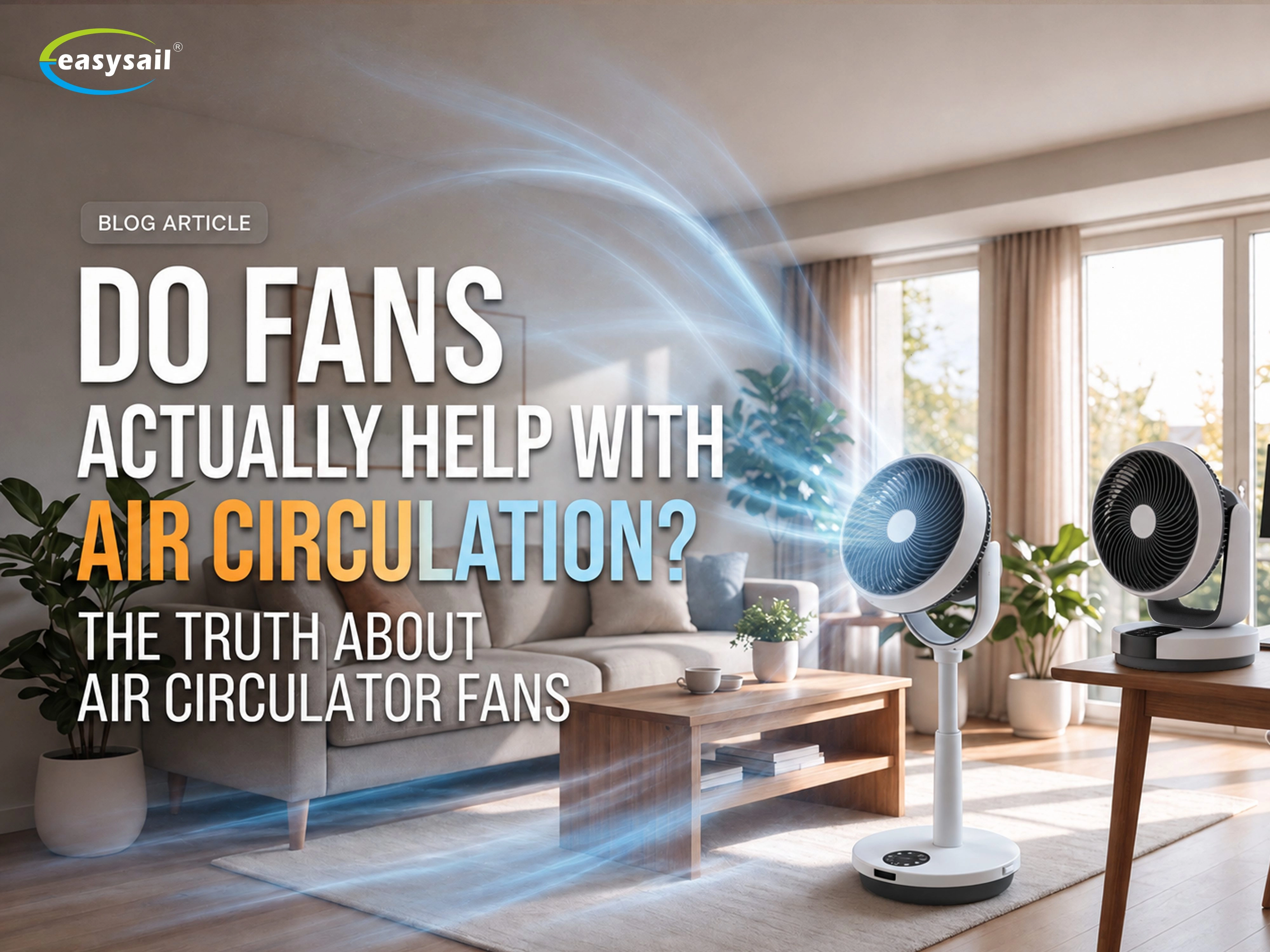
Do Fans Actually Help with Air Circulation? The Truth About Air Circulator Fans
Top OEM Air Cooler Manufacturer: Energy-Saving & Eco-Friendly Cooling Solutions

HWA-M Electric Wire Heater with Adjustable Thermostat
The Easysail HWA-M electric wire heater features 3 heat settings (Low Medium High) and an adjustable thermostat for flexible temperature control. Designed with a power indicator light and tip-over safety function, it ensures safe and reliable heating with simple and durable operation.

White Electric Ceramic Heater HPA-1
Easysail’s White Electric Ceramic Heater HPA-1 offers efficient, portable warmth with advanced ceramic technology. As a leading electric ceramic heater manufacturer, we ensure reliable performance and safety. Ideal for home or office, this compact heater delivers fast, energy-saving comfort wherever you need it.

HPA-1 PTC Electric Heater with Dual Heating Elements LED Display
The Easysail HPA-1 electric heater features dual PTC heating elements for fast and efficient heating. With LED display and electronic control, 3 modes, and adjustable temperature from 18–35°C, it ensures precise comfort. The remote control, 60° oscillation, timer, and safety protection system provide convenient and reliable use.

Electric Ceramic Heater HPA-S
Experience cozy warmth with the Easysail HPA-S Electric Ceramic Heater. This energy-efficient electric heater delivers fast, consistent heat, making it an ideal ceramic heater for any space. Enjoy reliable comfort and lower bills.
Get the Latest Updates
Have a specific question or need more details?
Fill out the form, and our team will get back to you with the information you need.

Easysail is a leading manufacturer specializing in the R&D, production, and sales of high-end two-season small home appliances.
Contact
We’re just a call away.
+86 757 2281 5038
Got a question?
YouTube
Instagram
Facebook