
Installation Tips for Optimal Performance of Air Circulator Fans
- Maximizing Air Mixing and Coverage through Strategic Placement
- Room geometry and circulation mapping
- Mounting height, tilt, and directional settings
- Coordinating with existing ventilation systems
- Electrical and Mechanical Best Practices for Reliability
- Specified power supply and wiring considerations
- Motor types, balancing, and vibration control
- Safety, grounding, and regulatory compliance
- Commissioning Procedures, Measurement, and Lifecycle Maintenance
- Measurement protocols for acceptance testing
- Routine maintenance schedules and spare-part planning
- Data-driven monitoring and ROI tracking
- Procurement and Project-Scale Considerations for Buyers
- Specification drafting for tenders
- Supply-chain resilience and factory audits
- Total cost of ownership and warranty models
- Easysail solutions for scalable, low-energy air circulation projects
- Frequently Asked Questions
High-performance room air movers require precise installation to deliver uniform thermal comfort, minimize electrical draw, and achieve predictable lifecycle costs—this guide condenses actionable placement, electrical, mechanical, commissioning and maintenance steps tailored for facility owners, procurement managers, and brand partners seeking low-energy, full-space circulation solutions while meeting international compliance standards (see Wikipedia: Fan, ISO 9001, and ASHRAE guidance).
Maximizing Air Mixing and Coverage through Strategic Placement
Room geometry and circulation mapping
Begin installations with a heat-load and airflow plan: delineate activity zones, heat gain sources, and high-occupancy areas. Position circulators to create crossflow patterns rather than point-to-point streams—placing units off-center and aligned to natural convection paths ensures faster mixing and fewer dead zones. For rectangular rooms, consider a staggered array to promote rotational airflow that reaches corners and reduces stratification.
Mounting height, tilt, and directional settings
Mounting height directly impacts velocity decay and coverage. For high-ceiling spaces, install oscillating circulators or units with vertical-angle adjustment at mid-height to direct airflow downward and induce convective mixing. For typical residential or retail ceilings (2.4–3.5 m), a mid-ceiling mount 2.1–2.4 m above floor optimizes uniformity while maintaining occupant comfort. Avoid low-slung placements that create uncomfortable drafts near workstations.
Coordinating with existing ventilation systems
Circulators should complement, not fight, mechanical ventilation. Integrate fan orientation and timing with the building HVAC schedule: use timed or sensor-linked operation to augment supply diffusers during peak cooling or heating cycles. This approach reduces reliance on central conditioning equipment and lowers system cycling—important for facilities aiming to optimize energy intensity metrics.
Electrical and Mechanical Best Practices for Reliability
Specified power supply and wiring considerations
Confirm voltage tolerance and power factor requirements before procurement. High-efficiency brushless DC units typically operate on a lower wattage budget but may require DC drivers or dedicated electronic controls; confirm compatibility with local supply characteristics and inrush current limitations. Use appropriately rated circuit breakers and include surge protection where lightning or industrial switching transients are risks. Document electrical load additions in single-line diagrams for auditability.
Motor types, balancing, and vibration control
Select motors with proven low-RPM torque curves and incorporate dynamic balancing during commissioning. Brushless permanent-magnet motors (EC/BLDC) offer the best steady-state efficiency and narrower control banding than AC induction motors. Install anti-vibration mounts and use torque-limited fasteners at structural interfaces to reduce bearing wear and noise complaints—especially critical for hospitality and office deployments.
Safety, grounding, and regulatory compliance
Ensure that installations observe relevant safety clearances, cable management, and grounding per local electrical codes. Specify models with recognized third-party approvals (CE, CB, ETL, KC) to streamline cross-border distribution and procurement acceptance. Maintain dossier copies of certificates to satisfy retailer or distributor compliance checks.
Commissioning Procedures, Measurement, and Lifecycle Maintenance
Measurement protocols for acceptance testing
Define acceptance criteria before installation: target air-change rates, average face velocity at key points, and maximum sound level thresholds. Use calibrated anemometers and infrared thermography during commissioning to validate the intended mixing effect and to detect flow obstructions. Capture baseline energy consumption with power meters to quantify projected savings versus central conditioning alone.
Routine maintenance schedules and spare-part planning
Establish preventive maintenance intervals tied to operating hours and environmental factors. Basic schedules should include quarterly visual inspections, annual bearing lubrication or replacement where applicable, and filter cleaning for enclosed units. Maintain a small spare-parts kit (motors, spare blades, control modules) to minimize downtime for distributed deployments or channel inventory requirements.
Data-driven monitoring and ROI tracking
Install runtime meters and integrate fan status into building management or IoT dashboards to measure kWh per circulation hour. Compare post-install energy consumption against baseline HVAC usage to calculate payback and validate energy targets—this quantification is essential for capital approval and scaling rollout phases.
| Device Type | Typical Power Draw (W) | Nominal Coverage (sq ft) | Use Case | Maintenance Interval |
|---|---|---|---|---|
| Standard AC Ceiling Fan | 30–75 | 200–400 | Local cooling, low cost | 6–12 months |
| High-efficiency DC Room Circulator | 10–35 | 400–700 | Whole-room mixing, low-energy continuous operation | 12 months (or runtime-based) |
| Central HVAC (AC Compressor) | 2000–5000+ | Whole building | Primary space conditioning | Annually |
Notes: Typical power ranges are industry-observed values used for preliminary planning; consult manufacturer datasheets for model-specific ratings. Comparative guidance from energy and HVAC authorities such as ASHRAE and general device descriptions at Wikipedia provide supplemental context.
Procurement and Project-Scale Considerations for Buyers
Specification drafting for tenders
When preparing RFQs, specify performance parameters rather than proprietary designs: state target airflow (CFM), allowable sound levels at 1 m, control interfaces (PWM, 0–10 V, smart connectivity), mounting options, and acceptance test procedures. Requiring third-party certifications and sample acceptance testing reduces delivery risk and shortens time-to-shelf for retail or e-commerce channels.
Supply-chain resilience and factory audits
Prioritize partners with certified production bases and robust QC processes to maintain consistent output across large volumes. Look for documented quality management systems, social compliance evidence such as BSCI, and the ability to produce inspection reports and traceability documentation—this reduces claims and speeds customs clearance on international shipments.
Total cost of ownership and warranty models
Evaluate vendors by lifecycle cost, not just unit price. Consider motor warranty terms, availability of certified spare parts, and after-sales responsiveness. Extended warranties and local repair training options are high-value for channel partners and institutional buyers with tight uptime requirements.
Easysail solutions for scalable, low-energy air circulation projects
Foshan Easysail Electrical Technology Co., Ltd., established in 2009 and headquartered in Shunde, China, is positioned as a strategic OEM & ODM partner for brands seeking turnkey household climate appliances. Our 6,000㎡ ISO9001- and BSCI-certified production base, combined with an R&D and engineering team of over 100 professionals, enables rapid prototyping and stable mass production that aligns with global compliance requirements such as CE, CB, ETL, and KC.
For large-scale rollouts, our manufacturing process emphasizes energy-efficient motor selection, rigorous dynamic balancing, and modular control options that integrate with common building automation interfaces. Easysail supports commercial buyers and distributors through detailed specification mapping, pre-shipment performance validation, and spare-parts provisioning—reducing project risk and optimizing product lifecycle economics.
Our product portfolio includes advanced air coolers, responsive electric heaters, and a range of household fans engineered for two-season usability and low operational wattage. With over 2 million units exported annually to 30+ countries, Easysail is a designated supplier for retailers, importers, and e-commerce sellers that require reliable supply chains and documented quality assurance. For procurement inquiries or to request technical dossiers and sample schedules, contact our sales team at ysh@myeasysail.com.
Installation tip summary: prioritize strategic placement for whole-room mixing, select EC/BLDC-driven units for the lowest operating draw, document commissioning metrics, and maintain a structured spare-parts inventory to minimize downtime and protect ROI.
To review product specifications and OEM/ODM service packages, reach out to Easysail via ysh@myeasysail.com.
Frequently Asked Questions
What mounting height provides the best whole-room mixing for a medium-sized office?
For medium-sized offices (approx. 300–700 sq ft), a mid-ceiling mount around 2.1–2.4 m above the floor is recommended to balance coverage and occupant comfort; for higher ceilings, combine downward tilt or oscillation to maintain effective mixing.
Which motor technology delivers the best lifecycle energy savings for continuous operation?
Brushless permanent-magnet motors (EC/BLDC) typically offer the best steady-state efficiency, finer speed control, and lower lifecycle energy consumption compared with traditional AC induction motors.
What certifications should procurement require to simplify international distribution?
Require third-party certifications such as CE, CB, ETL, and KC, and verify that the supplier operates under a quality management system like ISO 9001; social compliance evidence such as BSCI is also important for retail channels.
How should performance be validated during commissioning?
Define acceptance criteria in advance and use calibrated instruments—anemometers for airflow, sound meters for acoustic limits, and power meters for energy consumption—to verify that installed units meet CFM targets, noise thresholds, and kWh projections.
What maintenance practices minimize downtime in large deployments?
Implement runtime-based preventive maintenance including quarterly visual checks, annual bearing or motor inspections, and maintain a spare-parts kit (motors, blades, control modules) to ensure rapid field repairs and reduce logistics lead time.
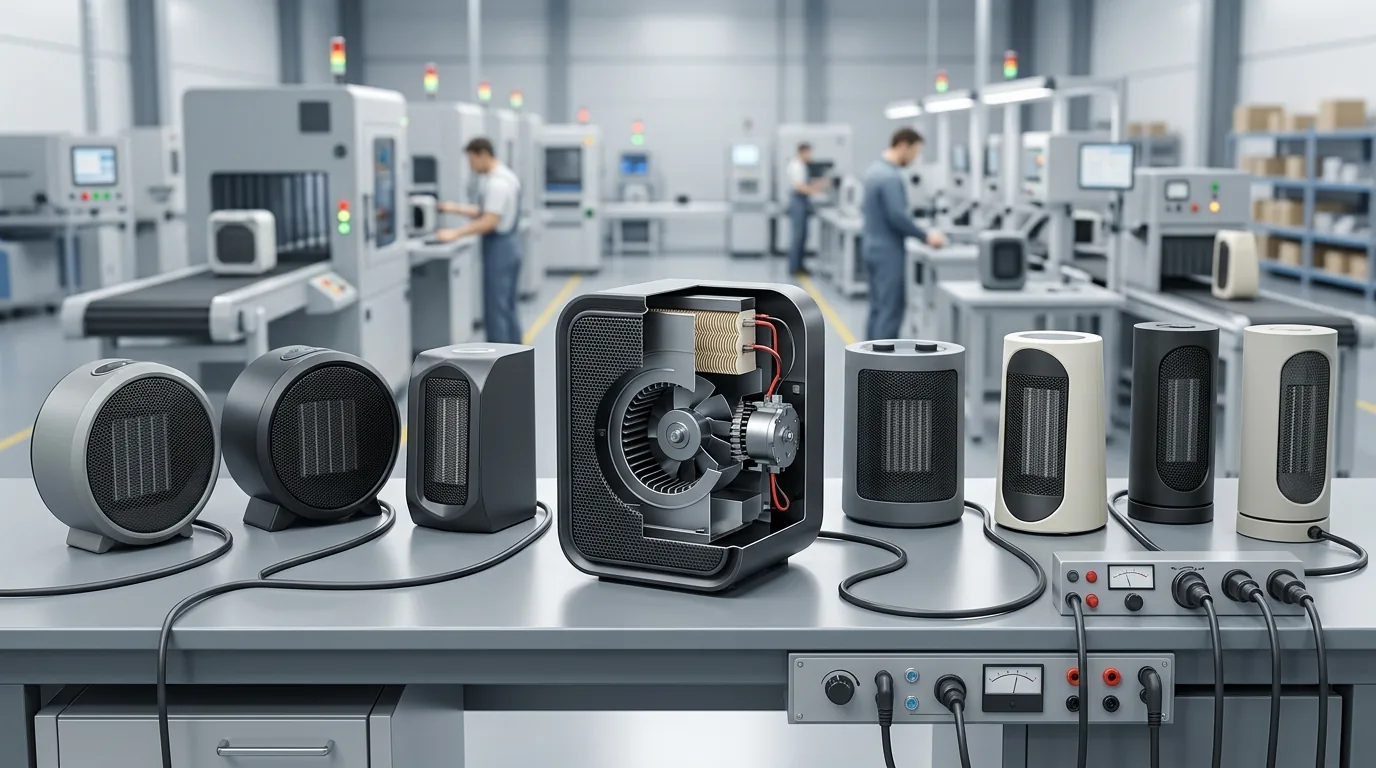
Space Heater Manufacturers: How to Choose an OEM/ODM Supplier (China)
Top 10 air circulation fan manufacturers and suppliers
OEM & Wholesale Options for Small Apartment Air Circulation Fans
Best oscillating air circulation fans for home manufacturers and supplier brands

HWA-M Electric Wire Heater with Adjustable Thermostat
The Easysail HWA-M electric wire heater features 3 heat settings (Low Medium High) and an adjustable thermostat for flexible temperature control. Designed with a power indicator light and tip-over safety function, it ensures safe and reliable heating with simple and durable operation.

White Electric Ceramic Heater HPA-1
Easysail’s White Electric Ceramic Heater HPA-1 offers efficient, portable warmth with advanced ceramic technology. As a leading electric ceramic heater manufacturer, we ensure reliable performance and safety. Ideal for home or office, this compact heater delivers fast, energy-saving comfort wherever you need it.

HPA-1 PTC Electric Heater with Dual Heating Elements LED Display
The Easysail HPA-1 electric heater features dual PTC heating elements for fast and efficient heating. With LED display and electronic control, 3 modes, and adjustable temperature from 18–35°C, it ensures precise comfort. The remote control, 60° oscillation, timer, and safety protection system provide convenient and reliable use.

Electric Ceramic Heater HPA-S
Experience cozy warmth with the Easysail HPA-S Electric Ceramic Heater. This energy-efficient electric heater delivers fast, consistent heat, making it an ideal ceramic heater for any space. Enjoy reliable comfort and lower bills.
Get the Latest Updates
Have a specific question or need more details?
Fill out the form, and our team will get back to you with the information you need.

Easysail is a leading manufacturer specializing in the R&D, production, and sales of high-end two-season small home appliances.
Contact
We’re just a call away.
+86 757 2281 5038
Got a question?
YouTube
Instagram
Facebook