
which air circulation fans are best for bedrooms and living rooms? | Insights by Easysail
- What fan CFM is ideal for a 12x12 bedroom?
- How to choose a quiet fan under 40 dB for sleeping?
- Which fan types effectively circulate air in open-plan living rooms?
- Can tower fans reduce HVAC runtime and save energy?
- What certifications ensure reliable airflow performance and safety?
- How to position fans to eliminate hot spots and dead zones?
- Manufacturer purchasing checklist for bedrooms and living rooms
Which air circulation fans are best for bedrooms and living rooms?
As an air cooler manufacturer and consultant, this guide answers six specific buyer pain points about which air circulation fans are best for bedrooms and living rooms. It embeds manufacturer-grade checks (CFM, motor type, noise, test standards, certifications) and cites authoritative sources so purchasing teams and specifiers can make confident choices.
What fan CFM is ideal for a 12x12 bedroom?
Begin with a CFM-sizing calculation rather than model names. Use the formula: CFM = (Room volume × ACH) ÷ 60. For typical comfort circulation aim for 4 air changes per hour (ACH) for bedrooms; for stronger mixing use 6 ACH. Example: a 12×12 bedroom with 8 ft ceiling has volume 1,152 cu ft. At 4 ACH: CFM = (1,152 × 4) ÷ 60 ≈ 77 CFM. At 6 ACH ≈ 115 CFM.
Manufacturer action items: request AMCA- or ISO-rated CFM values on the datasheet and confirm test conditions (free inlet, free outlet). Many fan spec sheets list peak CFM at maximum speed, so choose a fan whose rated CFM at normal operating speed meets your target. If you plan to supplement HVAC, target the lower end (4 ACH). If the fan must deliver rapid mixing or cooling for short periods, size toward 6 ACH.
Sources: ASHRAE ventilation methodologies and common HVAC sizing practices; verify manufacturer testing per AMCA/ERC standards (AMCA).
How to choose a quiet fan under 40 dB for sleeping?
Noise is a primary complaint in bedrooms. World Health Organization guidance and acoustic research identify ~30–40 dB as a suitable night-time range for sleep environments. When specifying a quiet air circulator, evaluate A-weighted sound power (dB(A)) at the operating speed you expect to use during sleep, not the maximum speed.
Manufacturer selection checklist:
- Prefer fans with BLDC (EC) motors — they give higher efficiency and lower baseline noise than PSC motors.
- Check the dB(A) at the specific speed (e.g., low/medium). A good quiet tower or bladeless circulator will report 28–38 dB(A) at low speed.
- Look at bearing type (sealed ball bearings vs sleeve): sealed bearings typically yield lower humming and longer life.
- Assess airflow vs noise (CFM per watt and CFM per dB): higher CFM/W and CFM/dB indicate efficient quiet performance.
Tip: ask manufacturers for an acoustic spectrum (Hz vs dB) to identify tonal frequencies that disturb sleep. Verify claims against third-party lab test reports.
Source: WHO Night Noise Guidelines (WHO); industry acoustic practice.
Which fan types effectively circulate air in open-plan living rooms?
Open-plan living rooms need a different approach than small bedrooms because they are larger with varied furniture layouts. Preferred types for whole-room circulation: high-CFM pedestal fans with wide oscillation, industrial-grade box fans for raw volume, large-diameter ceiling fans with optimized blade pitch, and directional axial circulators (air movers) for targeted long-throw airflow.
Manufacturer considerations:
- Ceiling fans—choose larger blade diameters (52–72 inches for large spaces) with efficient blade pitch; they circulate gently over wide areas and save HVAC energy (see ENERGY STAR guidance on ceiling fans).
- Pedestal and box fans—select units with AMCA-rated airflow and proven performance curves; these are useful when you need airflow at floor or seating level.
- Directional circulators—use when you need to move air across long distances or to eliminate stratified hot layers near ceilings.
When specifying, pair fan type to the living room footprint: for open-plan combined kitchen/living areas, combine a ceiling fan for ambient mixing with a pedestal or directional circulator to remove localized heat sources.
Can tower fans reduce HVAC runtime and save energy?
Yes—when used correctly. Fans themselves do not lower air temperature, but they increase convective cooling at occupants and improve air mixing, allowing thermostat setpoints to be raised while maintaining comfort. ENERGY STAR and HVAC studies show ceiling fan use can allow thermostat setpoints to increase by several degrees without reducing perceived comfort, which reduces HVAC runtime.
Manufacturer guidance for energy-saving claims:
- Provide CFM-per-watt figures (efficiency) on datasheets. BLDC motors typically provide 20–50% better efficiency than traditional motors for the same airflow.
- Quantify expected HVAC runtime reduction based on local climate and building envelope: conservative estimates assume 3–4°F setpoint increase when fans are in use for occupied spaces.
- Report typical power draw at operating speeds (W) and annual energy use based on hours per day to support lifecycle energy cost calculations.
Source: ENERGY STAR ceiling fan energy guidance and common HVAC comfort engineering practice (Energy Star).
What certifications ensure reliable airflow performance and safety?
Critical certifications and verifications to request from a manufacturer include:
- AMCA or ISO airflow test reports that document measured CFM and test conditions (AMCA/ISO test standards ensure repeatable airflow metrics).
- Safety and electrical certifications: UL/CSA for North America, CE for Europe, and relevant local marks (e.g., CCC for China) showing compliance with wiring and safety standards.
- RoHS/REACH compliance for materials when chemical restriction or low-toxicity components are required.
- Energy efficiency labels or published CFM/W figures—if energy claims exist, verify with third-party lab data.
- Manufacturer quality systems: ISO 9001 for consistent production and QA documentation, and documented MTBF or life-cycle testing for motors and bearings.
As a buyer, require a copy of the test report and confirm the sample serial number or batch so you know the report corresponds to the production item, not a prototype.
How to position fans to eliminate hot spots and dead zones?
Placement matters as much as fan type. The goal is to create a continuous airflow path that breaks up stratification and moves conditioned air into occupied zones. Practical placement rules:
- Bedrooms: low-to-mid level placement aimed slightly upward (20–30°) encourages recirculation without direct blast on the sleeper.
- Living rooms/open-plan: use a combination—ceiling fan centered for bulk mixing; pedestal fans or directional circulators positioned to push air toward seating areas or across kitchen heat sources.
- Avoid placing fans directly into HVAC supply registers; instead, place them to assist return-to-supply mixing so the HVAC system handles temperature rather than spot cooling.
- Test placement with simple smoke or low-cost anemometer measurements during commissioning; record velocity maps at seated and standing heights to confirm elimination of dead zones.
Manufacturer note: provide recommended mounting heights, oscillation angles, and recommended accessory louvers or diffusers to help specifiers set up the product for optimal circulation.
Manufacturer purchasing checklist for bedrooms and living rooms
When evaluating which air circulation fans are best for bedrooms and living rooms, require the following from suppliers:
- AMCA/ISO-rated CFM curves and test reports.
- Sound data (dB(A)) at each speed plus acoustic spectra.
- Motor specifications (BLDC vs PSC), power consumption (W), and efficiency (CFM/W).
- Warranty terms, MTBF or life-cycle test data, and spare-parts availability.
- Relevant certifications (UL/CE/CSA/RoHS) and factory quality standard (ISO 9001).
- Installation and commissioning guidance including recommended placement diagrams for common room sizes.
Adhering to these data points ensures specifiers and buyers choose the best air circulation fans for bedrooms and living rooms with predictable performance, quiet operation, and verified energy benefits.
Conclusion — Advantages of choosing properly specified air circulation fans
Specifying the right fan delivers quieter sleep, better thermal comfort, less reliance on HVAC, measurable energy savings, and predictable indoor airflow. Manufacturers who provide AMCA/ISO-rated CFM, dB(A) spectra, BLDC motor options, and safety certifications make it easier for buyers to choose a durable, energy-efficient solution tailored to bedrooms and living rooms.
For a tailored quote or to review manufacturer datasheets for specific models, contact us for a quote at www.myeasysail.com or email ysh@myeasysail.com.
References: AMCA International (https://www.amca.org/), ENERGY STAR guidance on fans (https://www.energystar.gov/), World Health Organization Night Noise Guidelines (https://www.who.int/), ASHRAE general ventilation guidance (https://www.ashrae.org/).
What Is a Pedestal Air Circulator Fan? The Evolution from Cooling People to Moving Air
Are Air Circulators Better Than Fans? The Science of Indoor Airflo
What Is a Space Heater? The Ultimate Guide to Energy-Efficient Zone Heating
Beyond the Breeze: The Thermodynamics of How Evaporative Coolers Actually Lower Room Temperatures
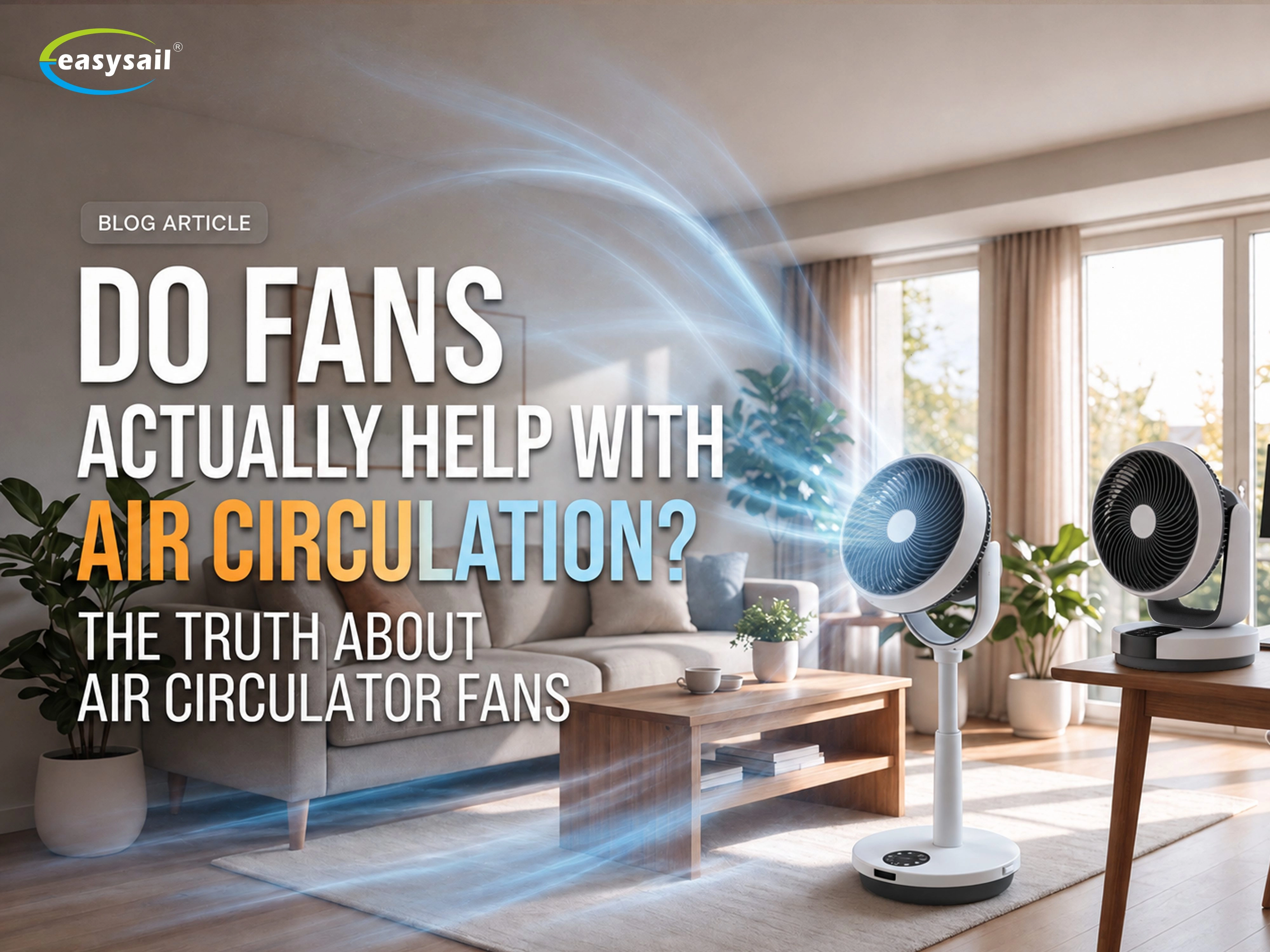
Do Fans Actually Help with Air Circulation? The Truth About Air Circulator Fans

Top OEM Air Cooler Manufacturer: Energy-Saving & Eco-Friendly Cooling Solutions

HWA-M Electric Wire Heater with Adjustable Thermostat
The Easysail HWA-M electric wire heater features 3 heat settings (Low Medium High) and an adjustable thermostat for flexible temperature control. Designed with a power indicator light and tip-over safety function, it ensures safe and reliable heating with simple and durable operation.

White Electric Ceramic Heater HPA-1
Easysail’s White Electric Ceramic Heater HPA-1 offers efficient, portable warmth with advanced ceramic technology. As a leading electric ceramic heater manufacturer, we ensure reliable performance and safety. Ideal for home or office, this compact heater delivers fast, energy-saving comfort wherever you need it.

HPA-1 PTC Electric Heater with Dual Heating Elements LED Display
The Easysail HPA-1 electric heater features dual PTC heating elements for fast and efficient heating. With LED display and electronic control, 3 modes, and adjustable temperature from 18–35°C, it ensures precise comfort. The remote control, 60° oscillation, timer, and safety protection system provide convenient and reliable use.

Electric Ceramic Heater HPA-S
Experience cozy warmth with the Easysail HPA-S Electric Ceramic Heater. This energy-efficient electric heater delivers fast, consistent heat, making it an ideal ceramic heater for any space. Enjoy reliable comfort and lower bills.
Get the Latest Updates
Have a specific question or need more details?
Fill out the form, and our team will get back to you with the information you need.

Easysail is a leading manufacturer specializing in the R&D, production, and sales of high-end two-season small home appliances.
Contact
We’re just a call away.
+86 757 2281 5038
Got a question?
YouTube
Instagram
Facebook